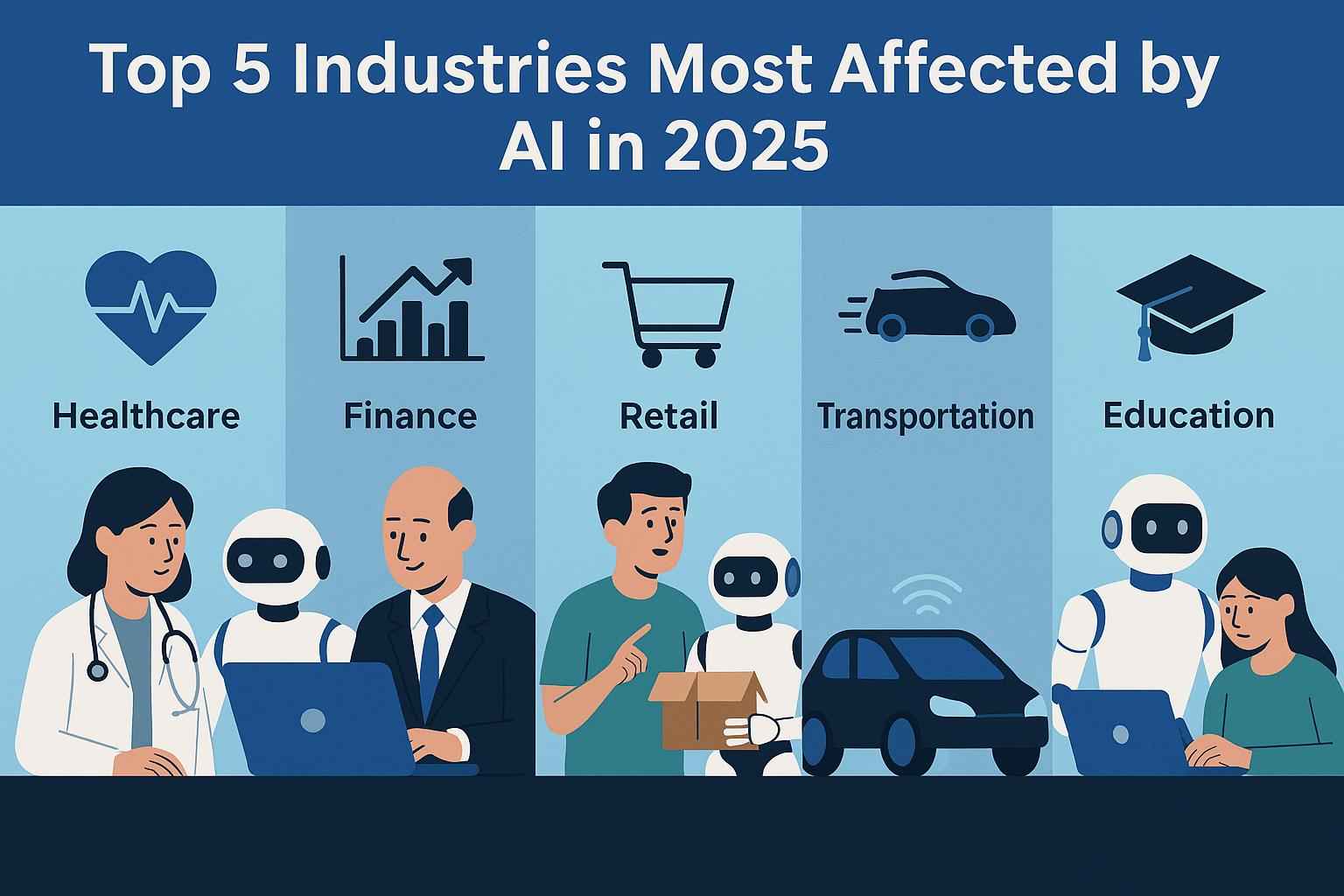
Top 5 Industries Most Affected by AI Innovations
AI is no longer just a buzzword, it’s a disruptive force shaping the future of every major industry. In this post, we break down the top 5 industries most affected by AI, what’s changing, and how businesses and workers can adapt in real time.
Whether you’re a business owner, tech enthusiast, or future-forward professional, understanding how AI disruption is impacting your industry is more important than ever.
Top 5 Industries Most Affected by AI And How They’re Evolving
- Healthcare: AI is Saving Lives in Healthcare
AI is transforming healthcare through faster diagnoses, personalized treatments, and operational efficiency.
- AI models analyze X-rays, MRIs, and lab results more accurately than ever.
- Virtual health assistants and chatbots handle basic consultations and follow-ups.
- Predictive algorithms can forecast disease outbreaks or patient readmissions.
Example: Google’s DeepMind AI diagnosed over 50 eye diseases more accurately than human doctors.
Impact: While AI won’t replace doctors, it’s augmenting them, reducing workloads and enhancing decision-making.
- Finance: AI is Reshaping How We Manage Money in finance
The finance industry is one of the most affected by AI due to its reliance on data, risk analysis, and prediction models.
- AI automates fraud detection, credit scoring, and customer onboarding.
- Robo-advisors manage investments and portfolios without human intervention.
- Algorithms power high-frequency trading and real-time market analysis.
Example: JPMorgan’s COiN AI platform reviews thousands of legal documents in seconds.
Impact: Financial professionals are shifting from manual tasks to strategic oversight of AI tools.
- Retail: AI is Personalizing the Shopping Experience in Retail Business
From e-commerce to in-store experiences, AI in retail is revolutionizing how people shop.
- AI offers real-time product recommendations based on user behavior.
- Inventory and supply chain are managed by predictive AI models.
- AI-driven customer service bots answer queries instantly.
Example: Amazon’s AI predicts what products you’ll buy next—sometimes before you do.
Impact: Retailers that embrace AI are seeing increased customer loyalty, faster delivery, and optimized logistics.
Transportation: AI is Driving Automation in Transportation
The transportation industry is undergoing a major shift thanks to autonomous vehicles and smart logistics.
- AI powers self-driving cars, trucks, and delivery drones.
- Route optimization reduces fuel consumption and delays.
- Predictive maintenance alerts prevent breakdowns.
Example: Tesla’s Autopilot and Waymo’s driverless taxis are real-world applications of AI in transportation.
Impact: While full autonomy is still evolving, logistics and delivery services are already reaping the benefits.
- Education: AI is Reinventing Learning in education
AI is making education more accessible, personalized, and data-driven.
- AI tutors provide instant feedback and adaptive learning paths.
- Teachers use AI to track student performance and tailor content.
- Language learning apps like Duolingo use AI to optimize user progress.
Example: Tools like ChatGPT and Khanmigo are helping students with real-time tutoring and writing support.
Impact: Educators are leveraging AI to enhance—not replace—human teaching and interaction.
Conclusion: AI Isn’t Coming. It’s Already Here. These are just 5 of the many industries most affected by AI, and the shift is accelerating. From finance to healthcare, AI is driving innovation, reducing costs, and unlocking new possibilities.
If you work in any of these sectors, now is the time to upskill and adapt to the changing landscape.